How AI-Powered Digital Twins Are Revolutionizing PCB Manufacturing
A plain-English guide to digital twins on a PCB assembly line: what they are, how AI predicts defects, and why engineers test changes on a copy first.
S
STIM CanadaEngineering team · Toronto
6 min read
Here's a slightly embarrassing truth about learning to fly: most pilots have "crashed" dozens of times before they ever touch a real aircraft. All of it happens in a simulator, which is sort of the whole idea. Mistakes there cost nothing but pride.
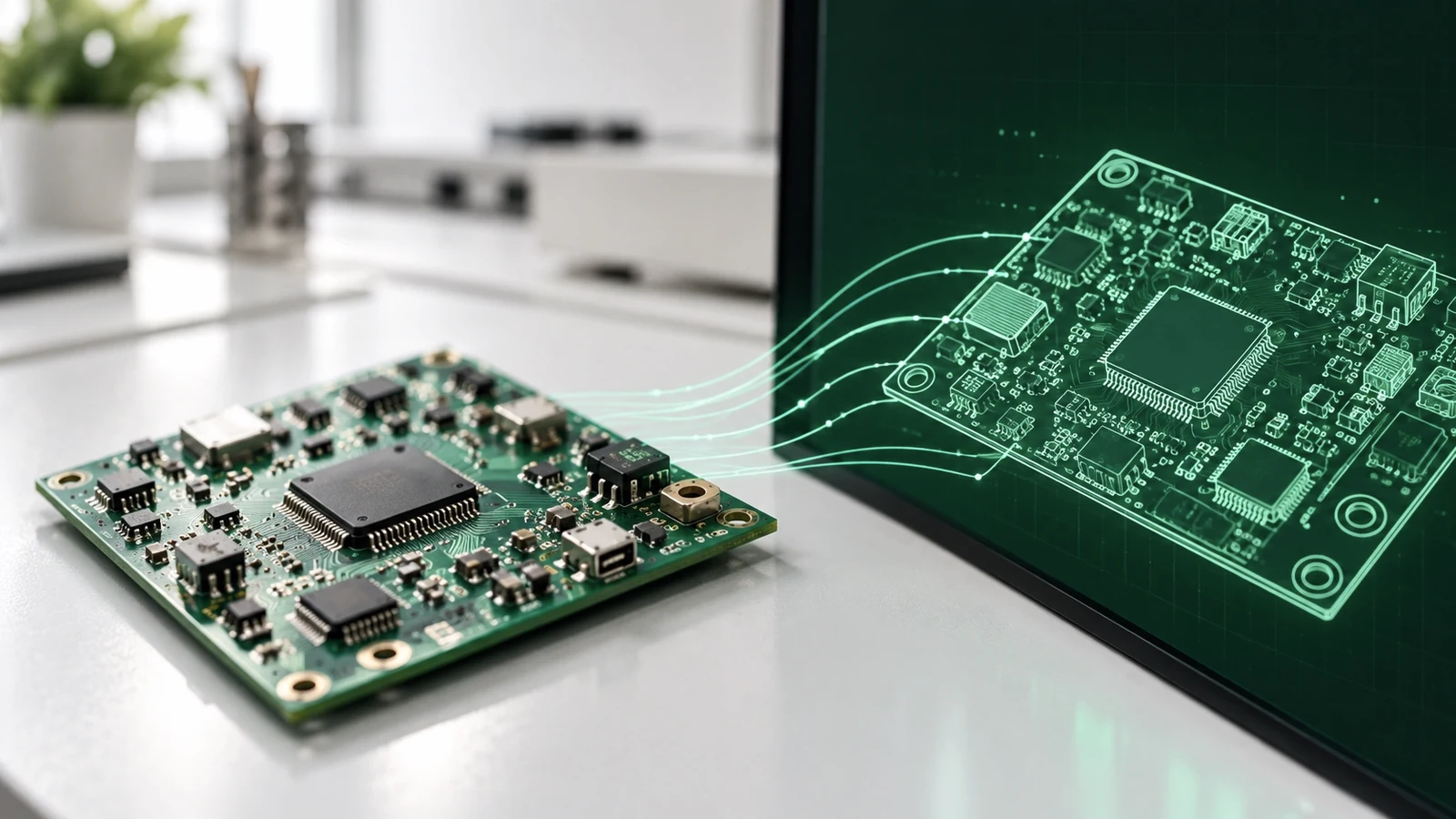
A digital twin in manufacturing is that simulator, pointed at a factory. Swap the cockpit for an SMT line turning out printed circuit boards. The twin is a software copy of the line (not a drawing of it, a working copy fed with live numbers), and engineers get to prod it, break it and learn from it while the real line keeps running.
Heard the phrase at a trade show and nodded politely? Fair enough. Most people have. Let's unpack it without the jargon.
What is a digital twin?
Strip it right down and a digital twin is a model on a computer that's hooked up to the real thing it models. Real thing changes, model changes.
Your phone's map app is a pretty good stand-in. Paper maps show roads. The app shows that the 401 is crawling at Keele right this minute, and it knows that because a few thousand phones stuck in the jam are pinging back their speed. A picture versus a mirror, basically. Digital twin technology is the business of building mirrors.
A twin isn't a drawing. It stays connected to the real board and line, so data flows in and adjustments flow back out.
IBM's version is tidier than mine: a virtual model that uses real-time data to reflect how its physical counterpart behaves. Aerospace engineers were playing with the idea decades ago. What's different now is price. Sensors got cheap, computing got cheap, and the idea wandered down from rocket programs onto regular shop floors.
OK, and the AI part?
Without AI, a twin is a really nice dashboard. It'll tell you what's going on. It won't tell you what's coming.
Machine learning fills that gap. Give it a few months of production history and it gets oddly good at noticing that small thing A tends to show up a day or two before annoying thing B. It's a forecaster, really. Nobody can cancel Thursday's thunderstorm, but a Tuesday warning means the patio cushions come inside in time.
How a digital twin in manufacturing works for PCBs
Quick tour of a surface-mount PCB assembly line first, since every stop on it feeds the twin:
Solder paste printing. Paste gets squeegeed through a steel stencil, thinner than a credit card, onto the board's pads. Think icing a cake through a cut-out.
Placement. Pick-and-place machines grab parts off reels and drop them onto the wet paste. Some boards take a few dozen parts; some take thousands.
Reflow. Into a long, multi-zone oven. The paste melts, wets the leads and cools into solder joints.
Each of those machines is chatty. The printer measures paste height on every deposit; the placer logs each mis-pick; the oven tracks zone temperatures; AOI snaps a picture of every joint. Data isn't the problem. The problem is that each machine keeps its own little diary and nobody's reading them side by side.
That's the twin's main job. It lines the diaries up. Board #4,812 fails at test? You can walk it backwards, station by station, and find the moment things started going sideways.
Every machine on the line feeds one live model, and the model's predictions flow back to the line as adjustments.
Defect prediction: catching problems before they happen
The usual way: a defect turns up at inspection, someone investigates, a fix goes in. By then a few hundred more boards may have gone through.
Prediction tries to jump the queue. An example. Paste in a few stencil apertures starts drying out, so deposits in one corner get thinner, a percent or two an hour, nothing dramatic. Each board passes, since every deposit is still within spec. But the twin has history. Last time this exact drift happened, it ended with weak joints under a fine-pitch QFN. So it flags the stencil, an operator wipes it, and that bad batch simply never exists.
That's the real story behind AI-driven PCB defect detection. Better cameras help, sure. The bigger win is tying a small upstream wobble to a failure several steps (and several hours) downstream.
The same slow paste drift, two outcomes: weak joints by hour 7, or a stencil wipe at hour 3 that resets it.
Where AI quality inspection fits
AOI that runs on fixed rules is famous for crying wolf. Shadows. A resistor rotated a hair but perfectly fine. A joint that looks odd and is actually okay. Operators burn a surprising chunk of every shift re-checking boards that were never bad in the first place.
AI quality inspection models learn from thousands of real good and bad joints instead of a rulebook, and in practice they tend to cry wolf less while still catching the real ones. A trained inspector still signs off, judging against IPC-A-610 workmanship criteria.
Process simulation: test changes without touching the line
Simulation is the "what if?" half of a twin. Instead of experimenting on real hardware, you quiz the model.
Bump the oven peak by 5°C: what happens? Purchasing wants to switch paste suppliers: does anything break? Asked on a live line, each of those questions costs boards, parts and hours of machine time. Asked of the twin, it costs a few minutes of compute. You still prove the answer with a real build; you just walk in with a short list rather than a hunch.
Most what-if questions can be answered on the model in minutes. Only the options that survive earn a real build.
It's most useful during new product introduction, when a board is being built for the very first time and nobody knows its bad habits yet.
Digital twin examples from the factory floor
Two that come up a lot:
Reflow profiling. Dense board, heavy copper ground plane, uneven heating. Getting the profile right normally means several runs with thermocouples taped to a sample board. A twin that models heat flow can suggest a starting point, which turns guessing into fine-tuning.
Predictive maintenance. A placement nozzle begins dropping a few more parts each shift. One extra reject an hour? Nobody notices. The twin does, and books a nozzle swap for the next planned break. That's predictive maintenance in manufacturing at its least glamorous and most useful: the machine gets fixed when it suits you, not at 2 a.m. on a Friday.
Same worn nozzle, two outcomes: a three-hour stop at 2 a.m., or a 20-minute swap in a planned break.
Traditional vs. AI-driven PCB manufacturing
The big shift is from finding problems after the fact to predicting them from earlier process data.
Area
Traditional approach
With an AI digital twin
Finding defects
After inspection or test
Predicted from earlier process data
Process changes
Trial and error on real boards
Tested in simulation first
Maintenance
Fixed calendar, or after a breakdown
Based on the machine's actual condition
Production data
Kept separately by each machine
Connected in one model
Root cause
Hours of detective work
Traced back board by board
What it takes (and the honest limits)
This isn't plug-and-play. A twin is only as good as what you feed it, and if your machines come from five vendors who don't share data nicely, or the data has holes in it, the predictions will be wobbly.
People still matter too, probably more than before. A process engineer who knows why a joint cracked beats a model that only knows that it cracked. The sweet spot is letting AI do the tireless watching while people do the thinking.
Under the buzzwords, an AI-powered digital twin is a pretty practical idea. Keep a living copy of the line, let software keep an eye out for early warning signs, and try risky changes on the copy before the real thing. On a PCB line, that adds up to fewer surprises at inspection, less scrap and calmer first builds.
Frequently asked questions
What is a digital twin in manufacturing, in simple terms?
A live virtual copy of a machine, a production line or a product. Data from the real equipment keeps it current, so engineers can spot problems early and try changes in software first.
Is a digital twin just a 3D model?
No, though people mix them up all the time. A CAD model or a one-off simulation is a snapshot. A twin stays connected to the physical thing and keeps updating.
Can AI replace human inspectors in PCB assembly?
Not really, and it isn't meant to. It's good at cutting false alarms and noticing slow trends, but the final call on an unusual defect still belongs to a trained inspector.
Do smaller manufacturers use digital twins?
More than you'd think. Hardly anyone models a whole factory on day one; most pick one process, like reflow profiling or nozzle maintenance, and build out from there.